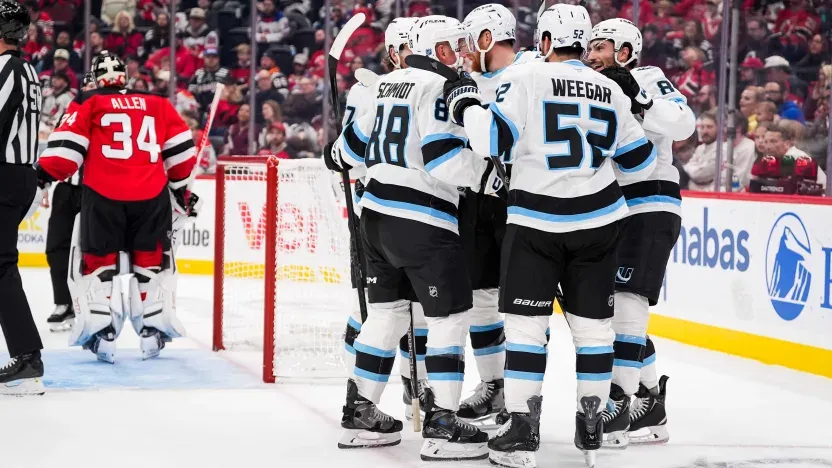
Utah beat the Devils 5-3 in Newark on Tuesday, and the NHL's data has the Mammoth as the team that cashed in at five-on-five, not the team that controlled it. Three of Utah's five goals came at even strength from about eight feet or closer to Jake Allen, each after a scramble or a Devils mistake. One of them, Lawson Crouse's at 19:03 of the second period, made it 4-2 and by the NHL's definition was the game-winner. The Devils had the better of the shot counts.
What the shot data says
New Jersey led in shot attempts (66-63), shots on goal (33-31), and shots on goal from inside 25 feet (17-15). At five-on-five the gap was similar: 45-42 in attempts, 21-20 in shots on goal, and 12-9 from inside 25 feet. The score came from conversion. Utah scored on three of its nine five-on-five shots from in close, and New Jersey on two of its 12. Distances come from the NHL's rounded coordinates, so treat them as approximate.
This was a different kind of win from the opener against Chicago, where Utah had 13 shots on goal from inside 25 feet to Chicago's three. It also looks nothing like Sunday in New York, where Igor Shesterkin stopped 14 of the 15 Utah shots from that range. Allen stopped 11 of 15 on Tuesday, and all four that beat him came from 12 feet or closer.
Three goals, one pattern
MacKenzie Weegar's goal at 1:42 of the second came six seconds after a Mikhail Sergachev shot on goal and four after one from Anders Lee, and it went in from about seven feet. Crouse's, from about two feet, followed a Nick Schmaltz shot and a Barrett Hayton miss within two seconds. Vincent Trocheck's at 16:52 of the third was an eight-foot tap-in after Schmaltz, as Deseret News described it, "came out of nowhere to intercept a breakout pass" and slid it across the slot.
Devils coach Sheldon Keefe didn't dispute that picture. "We weren't clean coming out of our zone," he said, according to NHL.com. "The goals against, they weren't even structure-related but habit-related. Stopping the puck, don't expose good ice, don't get beat back to your net." The Devils blog All About The Jersey walked through the same sequences and put the Crouse goal on a bad Jonas Siegenthaler pass and a poor backcheck.
We agree with that, and it's why we'd go easy on the idea that Utah dominated. The blog also wrote that the Mammoth "manhandled the softer Devils all night, controlling pace, all three zones, chances, special teams." The numbers don't back it. The same recap has the Devils up 11-8 in shots on goal and 5-3 in high-danger chances after the first period, and the NHL's data agrees on the shots. New Jersey also led in shots on goal in the third, 12-9. The AP's line that Utah "relied on their proficient power play" is a fairer read of the headline, but the power play scored two of the five goals, and the winner came at even strength.
Fans on r/Utah_Hockey saw the shape of it too. One called it "a greasy one but I’ll take it." Another, in the game-day thread, wrote, "Some high effort dirty goals tonight, this has been what we were missing last season!" We can't check the last-season half, but the first half holds up.
The names Tourigny picked
André Tourigny's postgame list is a decent test of what the team thinks wins this way. He singled out Kevin Stenlund, Lee, Andrew Peeke, Crouse and Jack McBain, and said "our fourth line was really good." The box score is on his side. Peeke had five blocked shots, the most on the team after Weegar's six, and Stenlund and McBain had two each. Lee's shot set up Weegar's goal and he got an assist, and Crouse scored the winner. Utah out-hit New Jersey 24-10 and blocked 21 shots to 14.
Tourigny also said, "I thought we were a little bit sluggish in the first. A lot of penalties, which led to kind of a sluggish momentum, and then I think we got better." The penalties were real. Utah took five minors and McBain's fighting major, and New Jersey took four minors plus Brenden Dillon's fighting major. The Devils scored on a five-on-three 18 seconds after Crouse's hooking call stacked on Weegar's roughing, and Utah killed the other four chances. Crouse's description fits the shot data: "They made a push, we made a push."
The third period, and what we can't say
The Hockey Writers called it "the best third period the team has had this season" and wrote that "the word for the third-period effort is mature." The result was mature. The shot quality is a harder sell. New Jersey took 29 attempts to Utah's 20 and had 12 shots on goal to nine, and seven of those 12 came from inside 25 feet. Vejmelka stopped six of the seven, and Jesper Boqvist's backhand at 9:49 was the one that got through. Trailing teams shoot more, so we wouldn't read too much into the volume. But Utah held the lead because its goalie did, and because Trocheck scored seven minutes after the Devils pulled within one.
We can't say how many of New Jersey's chances came off Utah turnovers. The NHL's feed has the Mammoth with more giveaways than the Devils, 24 to 22, so the mistakes weren't all on one side. Sergachev also left with 29 seconds left in the second period after Weegar's clearing attempt hit him, according to NHL.com, and Tourigny had no update afterward. He had three assists and 15:04 of ice time.
Utah is 3-1, with wins built on territory against Chicago, the power play against Columbus, and net-front scraps against New Jersey. Scrambles go in at a rate no one can predict, and the Mammoth were outshot from in close at five-on-five, so this is the result to be skeptical of. If Sergachev misses time, we'll find out whether the players Tourigny named can keep doing this while giving up more chances than they take. Utah plays at Boston on Thursday.
Tusks up.
Sources: NHL.com game story (Utah Mammoth), NHL.com recap, NHL.com box score and play-by-play data (shot locations, periods, and strength splits are our analysis of the NHL's coordinates, so treat distances as approximate), Deseret News, The Hockey Writers, All About The Jersey, AP via KUTV, r/Utah_Hockey postgame thread. The team's postgame notes weren't posted when we checked.