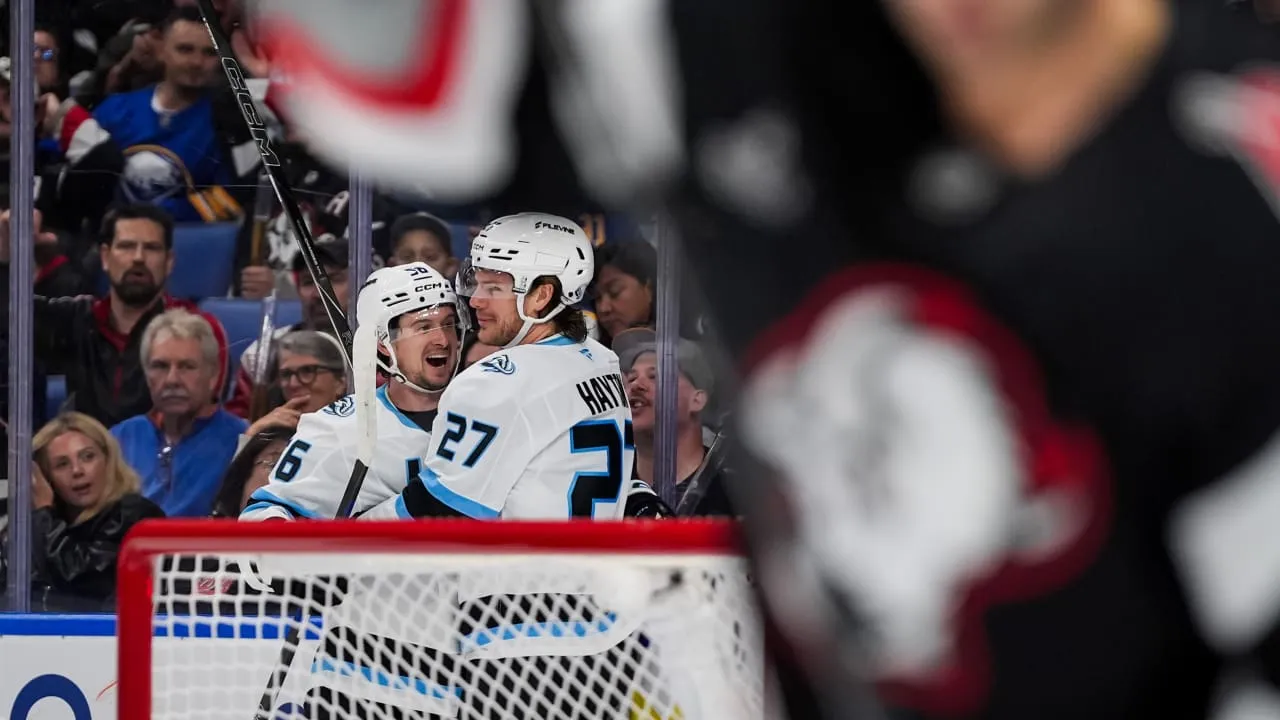
Utah beat Buffalo 4-1 on Saturday to finish the road trip 3-2, and the story that wrote itself was the bounce-back after Thursday's 6-1 loss in Boston. The numbers don't support it as a fix. At five-on-five, Utah had 58 percent of the shots on goal in Boston (26-19) and 57 percent in Buffalo (21-16). Shots from inside 25 feet were 14-8 Thursday and 10-5 Saturday. The team that got steamrolled, as one writer put it, outshot the Bruins 37-22 and had 80 attempts to 35. What changed was what sat on top of those shots.
Even strength was the same game
Yardbarker called Saturday "a complete 180 from the game prior" and wrote that it "was not the Mammoth team that got steamrolled." At even strength, our read of the NHL's data is that it was the same team. Attempts did slip, from 60-30 in Boston to 56-46 in Buffalo, so the Sabres got more of the puck. But the shots that reach the goalie and the ones from in close barely moved.
The five-on-five scoreboard moved a lot. Boston won those minutes 3-1 and Utah won them 2-0 in Buffalo. Utah's goalies stopped 16 of 19 even-strength shots Thursday and 16 of 16 Saturday. By our approximate coordinates, all six Boston goals came from 26 feet or farther, and the Bruins went scoreless on their eight shots from inside 25. To us that reads more like a bad night in net than a bad night of defense.
The special teams swung it
Three of Boston's goals came on the power play, each on one of the Bruins' three power-play shots, after Utah took three minors. Utah went 0-for-7 on its own power play, with 11 shots on goal. Saturday that flipped: Utah scored on 2 of its 5 chances (7 shots), and Buffalo scored on 1 of 4.
Anders Lee told NHL.com, "I think we won the special teams. I thought the PK was great, had a ton of blocks." The blocks are real; the NHL box score has Utah with 23 to Buffalo's 19. The kill still allowed 16 attempts and eight shots on goal in four Buffalo chances, which is more than Boston managed in three. Karel Vejmelka stopped seven of the eight. Tage Thompson, who scored Buffalo's goal, called it "a pretty fluky power-play goal." It ended an 0-for-13 start for Buffalo.
Our take: the kill worked because Vejmelka did, not because Buffalo was kept to the perimeter. The power play is a different case. Both goals came within about a minute of a Buffalo penalty (63 seconds after the delay-of-game call for Schmaltz, 73 after the holding call for Marino), and Utah now leads the league at 10 goals in 25 chances. We said after Columbus that special teams can decide any single game. They decided two in a row, in opposite directions.
Who played in goal, and why
Sebastian Cossa started in Boston, allowed three goals on eight shots, and left after 15:51. Vejmelka stopped 11 of 14 in relief, then started Saturday and stopped 23 of 24, including all six shots Buffalo took from inside 25 feet in the third period. The team's pregame notes show Cossa started Columbus and Boston, and Vejmelka started the other three games before Saturday. We couldn't find a word from Tourigny on why Vejmelka started Saturday, so we won't guess. He had played nearly 44 minutes two days earlier and was still the choice.
What the reshuffle did change
Tourigny did change the lineup. Deseret News reported that Lawson Crouse moved to the first line, Vincent Trocheck to the second, Lee to the third, and Jack McBain to the fourth, with Kailer Yamamoto in for the injured Michael Carcone. The effect shows up on the third line. Per the NHL's scoring summary, Yamamoto scored the first even-strength goal off a Barrett Hayton pass, Lee scored the second with Yamamoto getting an assist, and Hayton and Lee assisted on Marino's power-play goal.
A fan in the postgame thread wrote that the "Bottom 6 DOMINATED at even-strength." We can't split shots by line from the NHL feed, so we can't confirm dominated. That's two goals, so we wouldn't build anything on it either. It is the one real difference in the box score from Thursday. The top six played about the same minutes: Logan Cooley 20:07 against 20:30 in Boston, Schmaltz 19:12 against 19:52, Trocheck 17:15 against 17:02. Lee's ice time dropped from 15:19 to 12:08, and he scored on it. Tourigny credited the effort: "we were physical, we were hard in our battles, we cut time and space, we had a lot of pace." Hits were 33 to 17. The Sabres' side agrees on the squeeze: Sabres.com says Buffalo managed 11 shots through two periods, and Lindy Ruff said his team had "guys that were squeezing the stick."
That last point cuts against us a little. Buffalo has 11 goals in five games, according to The Hockey News, and a struggling offense makes any bounce-back easier. Boston scored six on Thursday.
What it changes
Nothing about the plan. Utah led at even strength in shots on goal in both games, and the swings came from the power play and the goalies, which can go either way. Yamamoto said "last game was just an off game." On the five-on-five numbers, that's close to what it was.
The test comes at home Tuesday against Toronto. Deseret noted that Utah went 4-6-1 in its first home game after multi-game road trips last season. The question is whether the same even-strength profile holds when the power play comes back to the pack.
Tusks up.
Sources: NHL.com game story (Utah Mammoth), NHL.com recap, NHL.com box score and play-by-play data (shot locations and strength splits are our analysis of the NHL's coordinates, so treat distances as approximate), Sabres.com postgame report, Deseret News, Yardbarker, The Hockey News, AP via KUTV, the team's pregame notes, r/Utah_Hockey postgame thread.